Channels, Masks and Night: Venice Awaits the Carnival
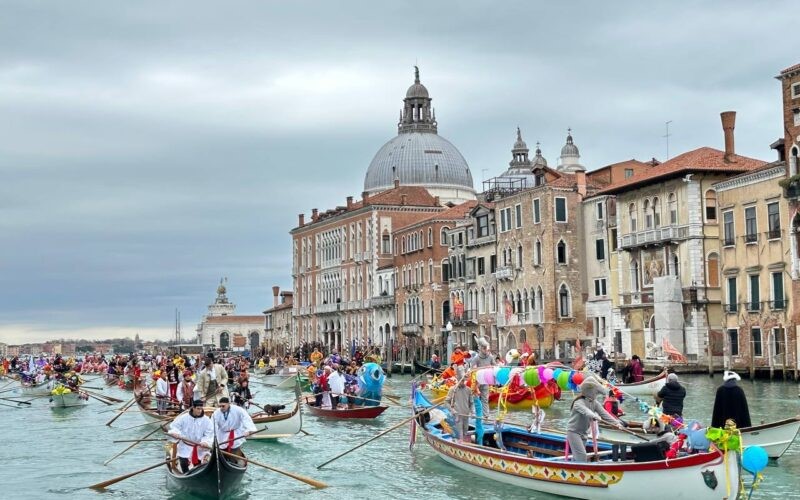
When night falls over Venice, the city becomes a place of shimmering reflections and quiet enchantment. Lanterns illuminate the stones of Piazza San Marco, while gondolas drift through the canals like moving shadows. During Carnival season, this already magical city turns into an open-air stage — where history, art and celebration merge.
Each February, Venice hosts one of Europe’s most iconic cultural festivals: the Carnevale di Venezia. For two weeks, the city fills with elaborate costumes, theatrical masks and music echoing through its narrow streets. In 2026, the Carnival will take place from 7 to 17 February, under the theme “The Origin of the Game, Olympus,” inspired by the upcoming Milan–Cortina Winter Olympics.
A Festival of Spectacle
The heart of the celebrations is Piazza San Marco, surrounded by architectural landmarks such as the Basilica, the Campanile and the Doge’s Palace. One of the most anticipated moments is the Flight of the Angel (Volo dell’Angelo), when a chosen performer glides down from the bell tower above the crowd, recreating a centuries-old tradition.
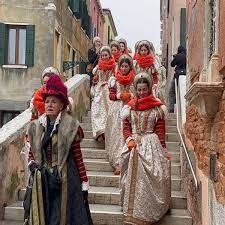
Another highlight is the Festa delle Marie, a historical parade held on the second Saturday. Twelve young Venetian women, dressed in magnificent Renaissance costumes, walk through the square in honour of a ritual dating back to the 16th century.
Beyond the official events, the entire city participates. Mask workshops, concerts and street performances transform Venice into a living theatre, where visitors and locals alike become part of the spectacle.
Roots in History
Carnival has deep origins in both pagan and Christian traditions. It marks the joyful final days before Lent, the forty-day period of fasting leading up to Easter. The word itself comes from the Latin carne levare — “to remove meat.”
Venice’s Carnival traces its roots back to Roman festivals such as Saturnalia, when social hierarchies were temporarily suspended. In 1296, the Venetian Senate officially declared Carnival a public celebration, and the city’s streets soon filled with musicians, acrobats and masked figures.
The festival reached its golden age between the 13th and 17th centuries, when masks allowed aristocrats and common citizens to mingle anonymously. After Napoleon’s conquest, the Carnival was suppressed, only to be revived in the 1970s. Today, it is recognised as a major element of Italy’s cultural heritage.
Masks as Symbols of Freedom
What makes Venice unique is the language of its masks. These are not mere decorations, but powerful cultural symbols:
Bauta, the classic full-face mask, allowed wearers to speak and eat freely and was often used in political gatherings.
Moretta, traditionally worn by women, embodied silence and elegance.
Volto (Larva), the white mask of anonymity, became one of the Carnival’s most recognisable icons.
Costumes of velvet, lace and gold embroidery recall the splendour of aristocratic Venice, while colours carry symbolic meaning: red for power, blue for wealth, black for mystery.
Venice, Past and Present
From grand masked balls inside palaces to street theatre along the canals, the Carnival continues to unite past and present. Traditional sweets such as fritole, warm chocolate and Venetian wine complete the sensory experience.
Ultimately, the Venice Carnival is more than a festival. It is a celebration of identity and disguise, of history brought to life, and of a city that every winter whispers the same message: here, time may pause — but the story never ends.