
News from Italy

The City Lights: Dante or Beatrice?
by Ayfer Selamoğlu
Nearly 700 years have passed since the death of Dante Alighieri, yet his works continue to inspire countless artistic creations. It is often said that all of his Works -especially the Divine Comedy, a true masterpiece- bear the influence of his Platonic childhood love, Beatrice. But is this really true? Was the source of those magnificent works the incomparable beauty Beatrice?
Dante Alighieri: the intellectual father of the European Union; a political thinker; the father of the Italian language; a literary theorist; a poet; a writer… A genius whose art and ideas contributed to the birth of the Renaissance. Alongside Shakespeare and Goethe, he stands as one of the foremost figures of Western European literature. In his Divine Comedy, where he portrays an ideal society and the significance of the individual, the deadly and universal sins he describes -such as anger, pride, envy, greed, gluttony, lust, and sloth- remain strikingly relevant today.
The real individuals he confronts in his Works -tyrants, fraudsters, religious exploiters, opportunists, egoists, and perpetrators of violence- continue to hold power even today. The Hell he depicts in the Divine Comedy is lived across the world: moral and social decay; struggles for power and profit; exploitation; hunger; destruction of nature; climate change; extinction of species; polluted seas; and deadly diseases surround us all.
A Knightly Ancestry
The year was 1265. Political storms raged in Florence, in Tuscany. On one of those gloomy days, Dante was born into a modest yet noble family. Their nobility traced back to his great-grandfather, a knight who had participated in the Crusades. His real name was Durante, both names meaning “enduring,” though he preferred the name Dante, common in the Middle Ages.
He lost his mother at the age of five; his father remarried but died when Dante was twelve. Dante, who disliked his father -a lawyer associated with dubious dealings- never mentioned him in his works. Instead, he proudly embraced his knightly ancestor, believing that true nobility came not from wealth but from heroic virtue.
Following the customs of the time, he was betrothed at twelve to Gemma Donati and married her eight years later. They had five children. After Dante’s exile from Florence, he would never see his wife again.
A Mind Turned Toward the Sun
Details of Dante’s formal education remain unclear, but it is evident that he lived according to Socrates’ idea that “knowledge is the nourishment of the soul.” Among his early mentors were Brunetto Latini and the poet Guido Guinizzelli. From Latini, he learned rhetoric and began writing in the vernacular.
Dante mastered several languages, including Latin, Provençal, and French. He studied classical authors deeply, especially Virgil, whom he regarded as his master. He also read Greek and contemporary Italian poets while cultivating knowledge in logic, rhetoric, grammar, astronomy, philosophy, and even painting.
He was influenced by Aristotle, Thomas Aquinas, and Virgil, and maintained friendships with prominent figures such as Guido Cavalcanti and Giotto. An increasing interest in political affairs, philosophy, and theology accompanied his intellectual and artistic pursuits.
Years of Social Transformation
Dante’s life coincided with a period of profound social change. The thirteenth century was marked by conflict, literary vitality, and rising patriotism. Feudal structures were collapsing, giving way to republics, kingdoms, and lordships.
Political factions were divided between the Ghibellines (pro-imperial) and the Guelfs (pro-papal), the latter further split into White and Black factions. Dante supported the White Guelfs, who advocated reform and the separation of church and state.
However, Pope Boniface VIII intervened in Florentine politics, supporting the Black faction. In 1300, with the assistance of Charles of Valois, the Whites were expelled. Dante was accused of false charges, fined, and exiled. Eventually, he was sentenced to death in absentia, marking the beginning of his long and productive exile.
Advocate of Separation of Powers
During his exile, Dante began to write extensively. He believed that God had given humanity two guides: the Pope for spiritual matters and the Emperor for temporal ones. When both abandoned their roles for power struggles, chaos ensued.
Through the Divine Comedy, Dante exposed corruption and offered a vision of moral and social redemption, emphasising that salvation lies in both individual and collective ethics.
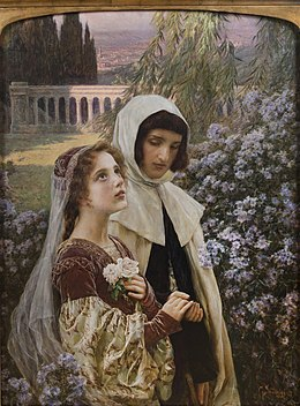
L’Amore per Beatrice
Beatrice fu la figura più importante della sua vita. Dante la incontrò da bambino e se ne innamorò perdutamente. Si incontrarono solo due volte. Beatrice morì giovane, a 24 anni, senza ricambiare l’amore. Dopo la sua morte, Dante la trasformò in un simbolo divino e perfetto.
La Divina Commedia
L’opera descrive un viaggio attraverso Inferno, Purgatorio e Paradiso. Virgilio guida Dante fino al Purgatorio, poi Beatrice lo conduce alla luce divina.
Beatrice fu probabilmente la scintilla iniziale. Tuttavia, l’opera di Dante non è solo frutto dell’amore, ma anche una sintesi di politica, teologia, filosofia e poesia.
Dante trasformò Beatrice in un simbolo della giustizia divina, unendo amore e pensiero in un capolavoro eterno.

Share: