
News from Italy

Caravaggio: The dance of darkness and light!
City Lights: Michelangelo Merisi, Caravaggio
by Andira Vitale
The first great artist of the Baroque art movement… The inventor of the fascinating dance of light and darkness… The father of the art of light and shadow used by Rembrandt and other painters… The first Baroque painter to use the intense contrast of light and shadow, also known as Tenebrism and Caravaggioism… He is Michelangelo Merisi, known as Caravaggio, one of the greatest artists Italy has produced…
Between successes and masterpieces, but also murders and obsessions, a journey to discover the painter who opened the doors to the Baroque.
Or a personality that confirms James Baldwin’s words, “artists are here to disturb the peace!”… Extraterrestrial… Terrifying… An obsessive understanding of art… In other words, he was someone who said, “I am restless, I am darkness, I wander on the edges of madness, you too should be restless, you should shiver”… According to some, he was a spooky, dangerous street thug, even a psychopath, a strange painter who never got out of trouble…
John Berger, who touched the world with compassion and managed to remain human, says the following to the woman he loves in the section of his book “Portraits” about Caravaggio:
“One night, in bed, you asked me who my favorite painter was. I didn’t know what to say to give the sharpest, most accurate answer. I said ‘Caravaggio’. My own answer surprised me. There were painters who were more noble, had broader horizons, painters I admired and could be heard more. But still, it follows that -the fact that the answer was given without preparation also contributed to this result- the painter I feel closest to is Caravaggio.”
If we consider that Berger is close to those who reject hierarchy, who oppose the injustice of the world, all kinds of power, the defeated, the oppressed, the resisters, the rebels, we can understand his closeness to Caravaggio…

If art is not only an aesthetic creation but also a means of expressing resistance, then this philosophy defines Caravaggio. Because his courage has no equivalent in art history. He is a rebellious revolutionary who destroyed all religious taboos, traditional structures and classical understanding of art of the period. He turned his back on the instructions of the Vatican, made himself accepted and his paintings were hung in churches. In that period when the Inquisition was ruling and the Pope was cutting his ticket to heaven, he managed to survive with paintings that humanized the gods. He made the nails of the saints dirty and depicted Mary as a prostitute. When asked to add angel figures to the empty space above St. Lucia, he was so outspoken as to say “if there are angels, show them!”
By the standards of the period, Caravaggio worked very quickly. So much so that it is said that “some parts of the canvas were sometimes left blank.” None of Tsaravaggio’s sketches have survived to the present day. This shows that Caravaggio worked without making any sketches.
Who is Caravaggio, whose life was spent among fights and magnificent works?
Caravaggio is one of the pioneers of the Baroque period, which was a rebellion movement against the ideal beauty of the Renaissance, theories consisting of triangle, fiction, perspective, light and shadow, three-dimensional perception and all the Renaissance masters.
To understand Caravaggio, it is necessary to take a look at Europe in the 1500s. A century had passed since the Renaissance, when the basic rules of art that are still accepted today were laid under the leadership of masters such as Da Vinci and Michelangelo. People were living in misery. Laws were used by lawmen for tyranny, and ruthless clergymen were corrupting their people under the rule of the church. There was no distinction between art and craft at that time. There were no galleries, exhibition halls or similar places. Churches were almost the only buyers of art. Paintings were ordered through strict contracts, and every detail from the subject to the figures and the colors to be used was conveyed directly to the artist. These were difficult times for artists who were excluded by the church. Caravaggio would be the first artist to dare to do this…
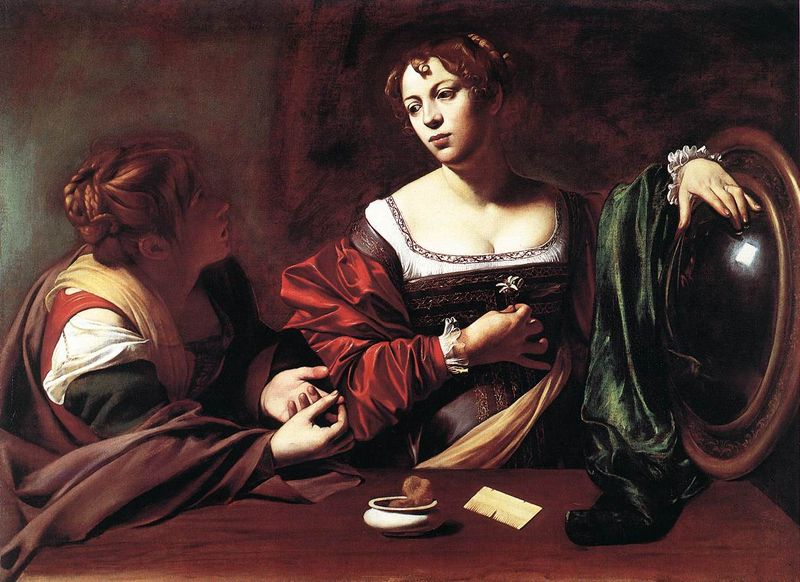
Martha and Mary Magdalene, 1598
Caravaggio, pseudonimo di Michelangelo Merisi, nasce il 29 settembre 1571 a Milano, dove i genitori Fermo Merisi e Lucia Aratori si erano trasferiti da Caravaggio, un piccolo feudo nella bergamasca che consegnò il celebre pseudonimo al pittore. Nel 1577 la famiglia Merisi fugge da Milano per proteggersi dalla terribile peste di San Carlo e fa rientro nel luogo natio ospite dei parenti. La malattia colpisce tuttavia il padre, il quale muore poco dopo assieme al nonno e a uno zio del futuro pittore. Nel 1584, il giovane Michelangelo torna a Milano e comincia un apprendistato da Simone Peterzano che dura per quattro anni. Tra il 1592 e il 1594, invece, lascia il capoluogo meneghino per recarsi a Roma. Degli anni precedenti alla partenza si conosce con certezza ben poco. In questo periodo il pittore potrebbe infatti aver soggiornato in Veneto col maestro e studiato da vicino l’arte di Tiziano, Giorgione e Tintoretto; oppure potrebbe aver avuto incontri ravvicinati con maestri lombardi come Bergognone Foppa, Moretto, Savoldo e Romanino. Di certo si sa che il 29 novembre 1951 scompare la madre Lucia e, spartita l’eredità, l’artista lascia Milano.
Caravaggio was an apprentice to a painter in Milan and learned basic art theories. In Rome, he copied the works of many painters and improved himself. However, Caravaggio interpreted these works in his own way and transformed them into different paintings. According to Caravaggio, Renaissance art was emotionless, and its ordinary imitation was far from real life. At first, Caravaggio could not make much of an impact on the world of painting. The city of Rome was fertile in terms of painters, but there was intense competition. We are talking about a period when the city was full of plague survivors and war escapees. But Caravaggio enjoyed living in these miserable, crowded and neglected conditions. He observed the swindlers, beggars, prostitutes and professional thieves who gathered on the streets, backstreets and public areas of the city and became friends with them.
“Michelangelo da Caravaggio who does marvelous things in Rome is someone who does not hold the works of any master in high regard, he says that all things are nothing but bagatelles, childishness or nonsense – whoever painted them – if they are not done from the truth, and that nothing can be better or better than following nature and copying it in painting.” (Karel van Mander)


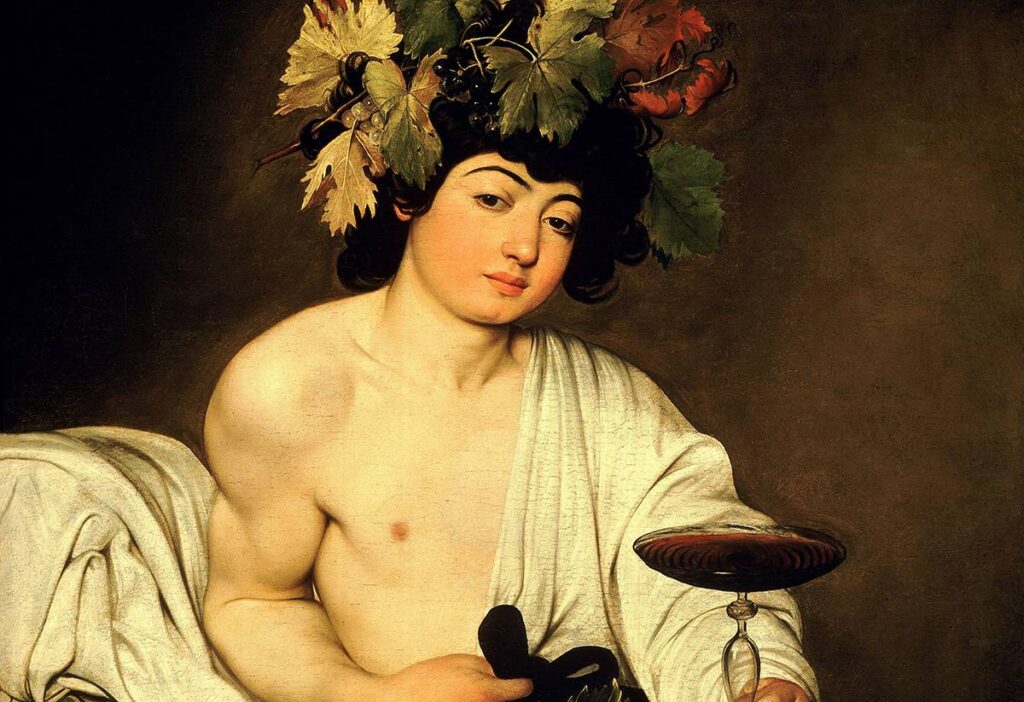
The Young Sick Bacchus, 1593 Boy Bitten by a Lizard, 1593-1594,
The first self-portrait of Caravaggio, then 22 years old, Sick Bacchus (1593) departs from the conventions of the time in a daring manner. This painting, in which Bacchus, the pagan god of revelry, drunkenness and sexual intercourse, is depicted as a victim, exasperated and even abused, is disturbing and disturbing. The vine leaves and grapes, promising drunkenness and pleasure, give the impression that they are being offered to a customer. The white himation resembles a sheet. The smile, however, appears fake. There are claims that this is actually an unhappy sex worker.
Boy Bitten by a Lizard, thought to have been painted at around the same time, presents another ordinary person who responds with a sudden shock without any rank or status. The painting is partially nude and with a rose behind his ear, suggesting a young man who has been sexually abused. The rose symbolizes romantic love, while the addition of jasmine is a traditional symbol of desire. The youth is bitten by a lizard while reaching for the cherries (real lizards do not have teeth). Both of these paintings should be interpreted in the context of Caravaggio’s target audience, the clergy.


The Fortune Teller, 1594 The Bards, 1594
Caravaggio was one of the first artists to develop genre painting by depicting the lives of ordinary people. The first archetypes are The Fortune Teller (1594) and The Card Sharps (1594), which shed light on the orders of the lower classes, were an important model for Caravaggio, and increased the realism of his art.
The originality of these two paintings, which brought to the fore the trickster class, which had not previously been seen as an important aesthetic subject on canvas, was a surprising phenomenon in late 16th-century Europe.
Caravaggio makes everyone who looks at this work an accomplice to the crime. An innocent young nobleman is about to be scammed by fraudulent gamblers. While the yellow and black costumes symbolize the wasps approaching the man, the chessboard on the edge of the table symbolizes that the young man has already lost his money. The painting is so striking that it is difficult to understand that the cheater and the victim are the same model. In this work, Caravaggio created two different characters by depicting the same model from both the front and the back. The third person looks at the cards of his innocent victim and signals to his accomplice. The cheater, whose back is turned, leans his shoulder forward a little more and makes a move for the fake card that he has hidden secretly. The striking realism of this work so impressed Cardinal Maria Del Monte that he placed the young artist’s work in a place of honor in his home. Caravaggio has managed to enter the heart of the church directly.

Judith Beheading Holofernes, 1598-1599 or 1602
Another famous example of Caravaggio’s realism and connection with ordinary people is Judith Beheading Holofernes. Caravaggio used Fillide Melandroni, a well-known prostitute who would have been easy for people in Rome to recognize, as his model for this work. This murder, carried out for religious reasons, is at the center of the painting. Renaissance painters focused more on nature than on human suffering. The torture and violence that existed in everyday life during the Counter-Reformation had a significant impact on art. Caravaggio painted the moment Holofernes was beheaded, and the victim’s head is halfway separated from his body, his eyes wide open in fear, and his mouth is screaming. Severed heads nailed to the Ponte S. Angelo bridge across the Tiber were a familiar sight in Rome. Judith is depicted as wearing the best clothes a woman could wear. Caravaggio also departs from religious tradition by depicting the servant next to the mistress. This is a very realistic representation of the working woman. The worker in question is directly inspired by life by showing her hands and the wrinkles on her face. Even her loincloth is seen as ready to pick up the severed head and throw it away. Caravaggio’s contemporaries thought that such a portrait was “too natural”. On the other hand, the servant is more prominent in contrast to the idealized beauty of Judith and even Holofernes. The servant was chosen as a third focal point that should not be missed and was depicted in this way. In this portrait, Caravaggio made use of the light/shadow contrast that would later become a characteristic feature of his works: it was emphasized with artificial light.


Saint Matthew and the Angel , 1602 The Raising of Lazarus, 1609
The first objectionable paintings:
The church commissioned this young talent to test him; he would paint Saint Matthew. The understanding of art at that time tended to humanize religious and mythological characters. He would paint Matthew as a divine being, and those who looked at the work would see what power and supernaturalness were. However, Caravaggio did not want this. He was an artist who looked for God on earth, not in the sky. Caravaggio had never seen an angel in his life. For this reason, he included elements that included both genders in his paintings. If a woman looked at the painting, she would see a masculine angel, and if a man looked at the painting, she would see a feminine angel. Matthew looks more like an old man eager to learn than a saint. The angel who teaches him to read is a bit coquettish. Visual arts are very important in Christianity. These works will be hung in churches and altars and people will pray in front of the painting. Therefore, it is expected that they will be painted accordingly. After the church gets over the initial shock, it orders the artist to paint the same subject again. Matthew should be painted in a more sublime manner, and the angel should be less coquettish!
Caravaggio reluctantly paints a new painting. In this second version of the painting, this time Matthew seems to be teaching the angel something. However, the sharp use of light and shadow, the more realistic style of painting and the very different way he approaches the subjects indicated that the churches were slowly starting to hear alarm signals. Caravaggio was becoming a danger to the church.
When he was painting the death of the Virgin Mary, the Raising of Lazarus, he took a real woman’s body that had drowned in the river from her grave and used it as a model. Moreover, he took a dagger and killed the body again in the name of realism. In some of his paintings, he used prostitutes as models and turned them into the Virgin Mary. Unlike the Renaissance, Caravaggio did not deify man, he humanized God. Perhaps this was why the church was no longer ordering from him, but from copyist artists. Caravaggio was criticizing and insulting his amateur copyists. Finally, someone took him to court and he was found guilty…

David with the Head of Goliath, 1610
The first murder..
After spending months in a single-room prison, his crime was commuted to house arrest. He was forbidden from leaving the house, but that didn’t stop him, he was thrown back in jail, this time attacking the officers who warned him. Caravaggio was now drawing a dangerous, aggressive profile.
Caravaggio’s women, murders and escapes…
Leda, one of Rome’s most beloved prostitutes, was also Caravaggio’s favorite. He used her as a model in most of his paintings and had a secret love for her. However, there was someone else in love with her; Mariano. This was reason enough for Caravaggio.
He challenged him to a duel. Mariano refused. A few days later, Mariano was attacked on the street at midnight, suffered serious injuries to his back and lost his life. (May 6, 1606) The murderer disappeared, no one had any doubts about his identity… Not long after, he challenged a man named Ranuccio Tomassoni, again because of a woman. And he killed Tomassoni in a duel. Rome put a price on his head. Judith is depicted as wearing the best clothes a woman could wear. Caravaggio also departs from religious tradition by depicting the servant next to the mistress. This is a very realistic representation of the working woman. The worker in question is directly inspired by life by showing her hands and the wrinkles on her face. Even her loincloth is seen as ready to pick up the severed head and throw it away. Caravaggio’s contemporaries thought that such a portrait was “too natural”. On the other hand, the servant is more prominent in contrast to the idealized beauty of Judith and even Holofernes. The servant was chosen as a third focal point that should not be missed and was depicted in this way. In this portrait, Caravaggio made use of the light/shadow contrast that would later become a characteristic feature of his works: it was emphasized with artificial light.
Rome announced that it had forgiven him. Now he could return home and start a new life… Caravaggio, who used the sea route to reach Rome, boarded the ship that would take him and his works. He had come to the end of his bad days, he was now cleansed. The exile that was full of regret and pain was over. He had to land near Palo Laziale and have the validity of the documents in his hands checked. However, either the officers there had not yet received the news that he had been pardoned, or they had mistaken him for another criminal, so they put him back in prison. When the situation became clear, Caravaggio ran to the dock, his mind had been on his paintings for days. However, it was too late..
The ship had already set sail with his works without waiting for him. Perhaps the ship had gone to Porto Ercole, which was 200 km away from where it was, the next port. Caravaggio hit the road, caught malaria in a swampy area. He started to have convulsions due to the heat of July. It is thought that Caravaggio was taken to a nearby hospital and died there. According to another rumor, he had a problem with the soldier there before he could reach his ship in Porto Ercole and was killed there. Some experts think that he was killed as a result of his relatives setting up another ambush for the murder he committed.
Caravaggio had a high fever at the time of his death, and what killed him was a matter of debate at the time. Historians long believed he died of syphilis. Some suggested malaria from unpasteurized dairy products, or possibly brucellosis. Some believed the Tommasoni family or the Knights had him killed in revenge. Some scholars have suggested that Caravaggio was attacked and killed by the same “enemies” who had been pursuing him since his escape from Malta, possibly Wignacourt and/or the Knights’ faction. Caravaggio’s remains were examined by researchers for a year in 2010. Initial tests suggested that Caravaggio may have died from lead poisoning. At the time, paints contained high levels of lead salts. However, a 2012 investigation concluded that Caravaggio died as a result of a wound sustained in a brawl in Naples, specifically sepsis caused by Staphylococcus aureus. Vatican documents published in 2002 reported that model Fillide Melandroni, a member of the wealthy Tommasoni family, sent a hitman to kill Caravaggio because of his love.
Caravaggio had a high fever at the time of his death, and what killed him was a matter of debate at the time. Historians long believed he died of syphilis. Some suggested malaria from unpasteurized dairy products, or possibly brucellosis. Some believed the Tommasoni family or the Knights had him killed in revenge. Some scholars have suggested that Caravaggio was attacked and killed by the same “enemies” who had been pursuing him since his escape from Malta, possibly Wignacourt and/or the Knights’ faction. Caravaggio’s remains were examined by researchers for a year in 2010. Initial tests suggested that Caravaggio may have died from lead poisoning. At the time, paints contained high levels of lead salts. However, a 2012 investigation concluded that Caravaggio died as a result of a wound sustained in a brawl in Naples, specifically sepsis caused by Staphylococcus aureus. Vatican documents published in 2002 reported that model Fillide Melandroni, a member of the wealthy Tommasoni family, sent a hitman to kill Caravaggio because of his love.
It is still a mystery how he died. But we know the date of his death. It was recorded as July 18, 1610. He was only 38 years old… We do not know whether he chose such a painful life because he wanted to, or whether this sharp knife between the rich and the poor ignited him. However, his art continues to shake the world even today. It is difficult to find someone in the world who is involved in art and does not admire Caravaggio.
Baroque was used as a word in the jewelry language to describe irregular and strangely shaped stones and pearls. It first emerged in Italy, and later spread to Europe and even Latin America. Artists who adopted the Counter-Reformation movement tried to create religious enthusiasm and excitement in their works. They also turned to areas other than the religious atmosphere.
“Why is Caravaggio so great? Because it is hard to believe that his ideas were conceived four centuries ago. Everything in his paintings, from the light to the cut of the composition, makes one think of an art that we recognize, a cast of sensibilities and experiences that are not those of the seventeenth century but those of every century in which man has been present and central; it can be called painting of reality, and to this it owes its incessant topicality. In front of a painting by Caravaggio it is as if we were attacked by reality, it is as if reality came towards us and he reproduced it in a totally mimetic way.” (Vittorio Sgarbi)
Share: