
News from Italy
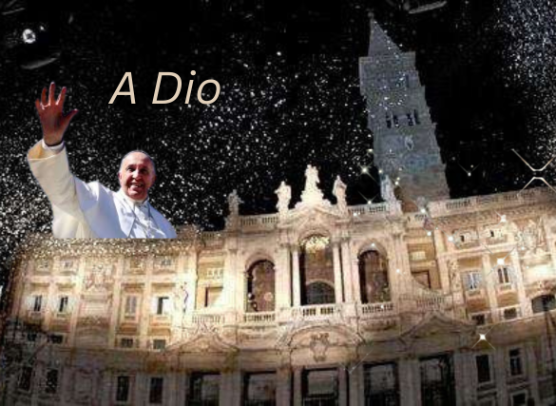
The Last Farewell to Pope Francis:
His last journey with his old black shoes
by Maria Stella
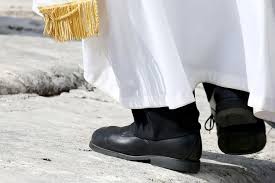
Francis, a Pope of humble and simple nature, embarked on his final journey. He eschewed the traditional red slippers symbolising the Pope, opting for the old black shoes he had worn for years. With a text written on what he had done as Pope, coins and seals minted during his time, and a white silk cover, he set off on his journey, a testament to his unwavering humility.
Since becoming Pope, he has always been the Pope of firsts. He was the first Pope from the Americas, a Jesuit Pope, and Pope to take the name Francis. He also made firsts in his death, being the first Pope to pass away on the morning of Easter. Most importantly, he fit all the values of the material and spiritual world into the last holy week. The calendars showed April 21, the birthday of the immortal city of Rome… The mourning ceremonies passed with a festival commemorating the foundation of humble Rome. Then came the Feast of Liberation, celebrated on April 25, 1945, to mark the end of Nazi fascism. The San Marco festival was celebrated in Venice on the same day. And the Venice Boccolo Festival, commemorating the love that the Pope attaches great importance to, was celebrated on the same day…


The Local Team’s live broadcast of Pope Francis’s funeral, which began at 10 a.m. on the steps of St. Peter’s Basilica, was a solemn event. It was attended by the great men of the Earth and hundreds of thousands of people who flocked to Rome to pay their last respects to the Pontiff who came “from the end of the world.” The overwhelming public attendance was a testament to Pope Francis’s impact on the world.
Pope Francis’ final journey began with the ceremonial closing of his coffin.
The veil, the coins, the shoes—these are not just items but significant symbols in Pope Francis’s funeral rites. The veil symbolises the transition from earthly life to the afterlife, the coins and seals minted during his time represent his legacy, and the old black shoes he had worn for years are a testament to his unwavering humility. Each element carries a profound meaning and is part of the rich tradition of the Catholic Church.
At 8:00 pm last night, a poignant moment unfolded as Pope Francis’ coffin was closed and accompanied by prayer. The private rite, held in the Vatican Basilica, a space closed to the faithful after three days, was a moment of solemnity and reverence. Despite this closure, 250,000 people gathered at St. Peter’s, a testament to the impact of Pope Francis. Some family members also attended the celebration. Pope Bergoglio’s wish to be buried with his old, worn-out black shoes, a symbol of his humility and a personal touch that resonates with many, instead of the traditional red slippers, a symbol of papal power, further underscored the individual nature of the event.
Held privately, the rite started at 8:00 p.m. at the Altar of the Confession. After the initial prayer, the Master of Liturgical Celebrations, a senior official responsible for overseeing the liturgical ceremonies of the Catholic Church, read the “deed,” a document that serves as a Testament to the life and works of the deceased Pontiff. This is a significant part of the ceremony, as it is a way to remember and honour Pope Francis’s life.
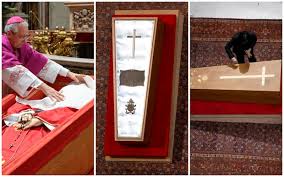
“Dearest brothers and sisters,” the celebrant said, opening the rite, “we will cover his face with veneration, in the living hope that he may contemplate the face of the Father, together with the Blessed Virgin Mary and all the Saints.” Some present signed the document, while the Canticle of Zechariah was sung. Ravelli placed a white silk veil on the Pope’s face at the end, while the Cardinal Camerlengo sprinkled the body with holy water. Then, Ravelli placed in the coffin a bag containing the coins and medals minted during Francis’s pontificate and the tube containing the deed, after affixing the Office of Liturgical Celebrations seal.
At this point, the coffin was closed: first, the lid of the zinc coffin on which are the cross, the coat of arms of the deceased Pope and the plaque bearing the name of the Pope, the length of his life, and his Petrine ministry. “The zinc coffin is welded,” reads the rite booklet. The seals of the Holy Roman Church’s Camerlengo, the Papal Household Prefecture, the Office of the Liturgical Celebrations of the Supreme Pontiff, and the Vatican Chapter are impressed. The wooden coffin is also closed. On the lid are the cross and the coat of arms of the deceased Pontiff.
The rite was closed by the singing of the Antiphons and the recitation of the Psalms. With the “Regina Caeli” at the end of everything, to renew the joyful announcement, the source of all authentic hope is “Christ is risen, alleluia!”.
St. Peter’s Square Funeral Ceremony: “Build bridges, not walls”
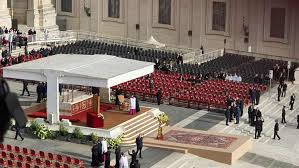
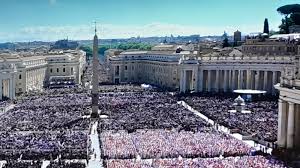
Pope Francis’ final journey ended today with a St. Peter’s Square funeral ceremony. The funeral mass was led by Italian Cardinal Giovanni Battista Re, Dean of the College of Cardinals. The Pope’s coffin was brought from St. Peter’s Basilica to St. Peter’s Square. As the coffin was carried to the square, the crowd frequently showed their love for Pope Francis. During the ceremony, prayers were sung in various languages, including Italian, Spanish, Chinese, Portuguese, Arabic, and Latin hymns. Many banners were carried in the square, including “You are our father, we love you very much, you have won our hearts with your simplicity and modesty. We will follow your advice”…
Battista Re began his speech by saying, “The expressions of love we have witnessed in recent days after his passing from this world to eternity tell us how much Pope Francis has touched minds and hearts.” The cardinal described Pope Francis as “a Pope who is open to everyone, among the people.” Battista Re said that the Pope faced wars in his final years and “continuously raised his voice to call for peace,” adding, “‘Build bridges, not walls’ is something the Pope has repeated many times.”
Cardinal Re also recalled Pope Francis defending migrants and marginalised people during the service. Re referred to Pope Francis’ visits to Lesbos and Lampedusa, two islands that symbolise “the tragedy of migration, where thousands of people drown at sea,” as well as the mass Pope Francis celebrated on the Mexico-U.S. border. Cardinal Re also reiterated the Pope’s enduring admonition: “Build bridges, not walls,” a phrase that has long been interpreted as a direct criticism of Trump’s policies. The crowd responded with spontaneous applause, especially to Re’s call for peace and dialogue in the face of war and destruction. This was one of the most emotionally significant moments of the ceremony.
“In the face of the inhuman horrors of recent years and the wars that have resulted in countless deaths and destruction, Pope Francis has consistently raised his voice, calling for peace and for reason and honest negotiation to find possible solutions,” Re continued.
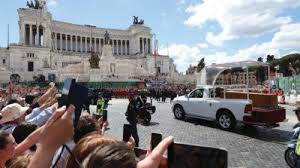
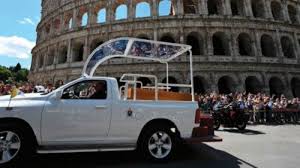
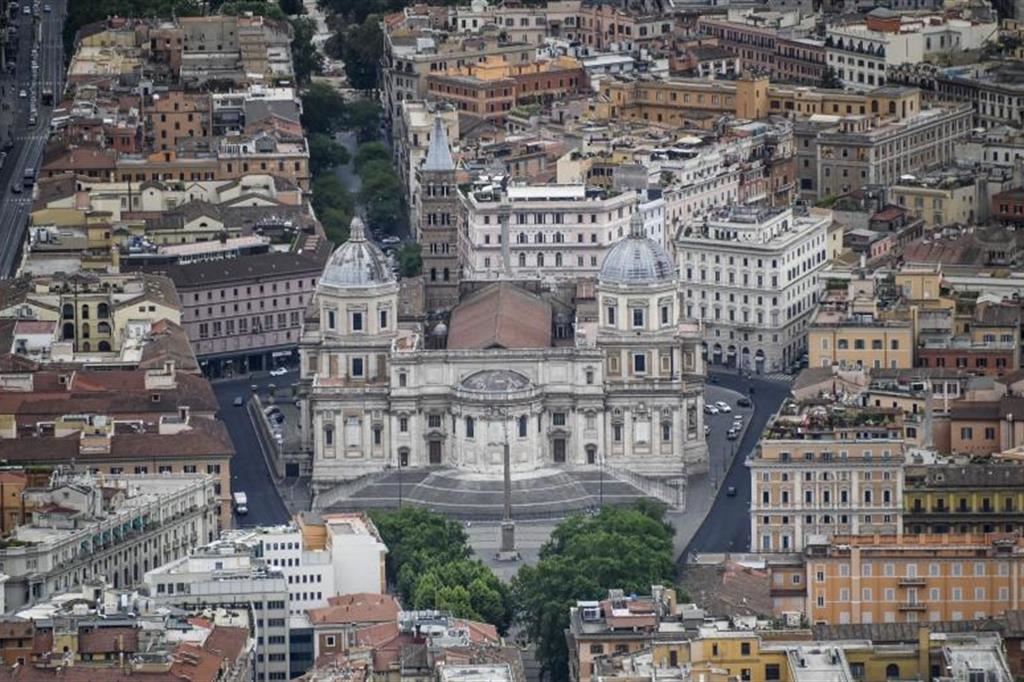
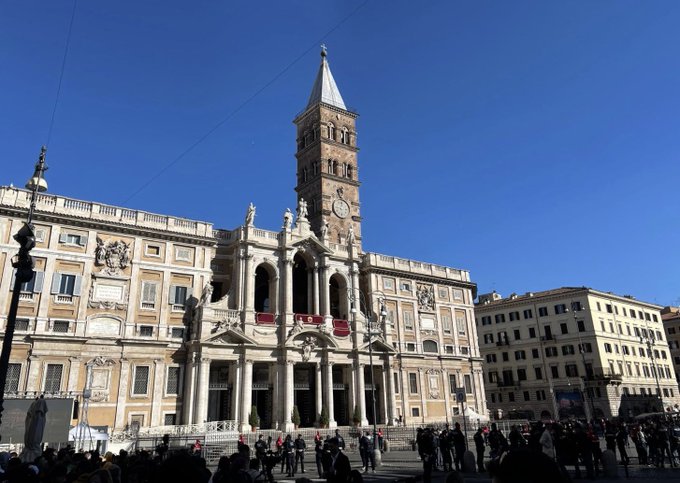
After the mass ended, the Pope’s coffin set off for the Basilica of Saint Mary the Great in Rome, where he stated in his will that he would be buried. After leaving the Vatican, the hearse carrying the Pope’s body toured Rome’s city centre. The funeral cortege, which was met with great public displays of affection, including tears, prayers, and flowers being thrown onto the procession route on streets such as Vittorio Emanuele Street, Venice Square, the Coliseum and Merulana Street, reached the Basilica of Saint Mary the Great, 6 kilometres from the Vatican.
The Pope’s final greeting was given to the “last in line of society”, whose exclusion the Pope opposes, such as the poor, immigrants, the homeless, transsexuals and prisoners who receive aid from the Vatican. This poignant moment serves as a reminder of the Pope’s unwavering commitment to these marginalised groups, evoking a sense of empathy and compassion in the audience. Bishop Benoni Ambarus, a Vatican official, who singled out the group of about 40 people who waited for the coffin in the Basilica with white roses in their hands, said that the Pope would be “greeted by his most beloved children” there. Avvenire, the Italian Catholic Church newspaper, also mentioned this in its headline yesterday: “Farewell to those at the end”.
It was announced that the burial inside the Church would not be open to the public. Vatican Spokesperson Bruni had announced that the Pope’s body would be open to public visits on Sunday after being buried in the Basilica of Saint Mary the Great.

Like the United Nations
Pope Francis’ funeral was not just a solemn event, but also a unique international gathering. The Catholic rite, with its tradition of the “peace sign” before Communion, was a particularly striking aspect. This gesture of peace, whether a handshake, a bow, or an embrace, was a formality and a bridge of international communication. It was a scene that Pope Francis would have cherished, as leaders who had tensions or had not seen each other for a while, used this greeting to establish a connection. According to Vatican rules, the cardinals sat on the left side of the Pope’s coffin at the front of the square, while international delegations were on the right. Among the state representatives, Italy, which hosts the Vatican, and Argentina, the Pope’s home country, came first. The royal families were followed immediately by state representatives, who lined up according to an old tradition, according to the countries’ French names. The leaders had the opportunity to meet before and after the ceremony.
The funeral was a gathering of not just mourners, but also many world leaders and international figures. Participants included Italian Prime Minister Giorgia Meloni and President Sergio Mattarella, as well as Argentina’s native Javier Milei, US President Donald Trump and former President Joe Biden, German President Frank-Walter Steinmeier, French President Emmanuel Macron, British Prime Ministers Keir Starmer and Prince William, Spanish King Felipe and Queen Letizia, Belgian King Philippe and Queen Mathilde, Brazilian President Luiz Inácio Lula da Silva and Ukrainian President Volodomir Zelensky. International figures such as UN Secretary-General Antonio Guterres and EU Commission President Ursula von der Leyen also attended. Many other countries also participated at the ministerial level.
Israel, which issued a message of condolence after the Pope’s death but later deleted it, causing controversy, was represented at the ambassadorial level. It was stated that the Israeli government’s cancellation of the message of condolence was due to the discomfort felt over the Pope’s criticisms about Gaza. Israeli Prime Minister Benjamin Netanyahu also issued a condolence message for the Pope only 3 days later, following the news and reactions. The Palestinian Authority was represented at the funeral by a delegation led by Prime Minister Mohammed Mustafa. Russian leader Vladimir Putin, for whom the International Criminal Court (ICC) has issued an arrest warrant, did not attend the ceremony; the Russian culture minister was seen among the participants.
The White House announced that Trump and Zelensky had a significant meeting before the funeral. Zelensky described it as “very productive” And “Symbolic with the potential to be historic.” He thanked Trump for the meeting. This was not the first time the two leaders had met; they last met at the White House in late February, but their disagreements ended with them arguing in front of cameras.
In addition to Trump and Zelensky, French President Macron and British Prime Minister Starmer met in the basilica just before the funeral.
It was reported that European Commission President Ursula von der Leyen, who has not been able to meet with Trump to date, also hoped to have a brief meeting regarding customs duties. When the leaders arrived at the square for the funeral, Von der Leyen and Trump were seen shaking hands and talking briefly.
According to the Vatican’s information, 400 thousand people attended the Pope’s funeral in the Vatican. According to the press, approximately 50 thousand people were alone in St. Peter’s Square, which was almost full.
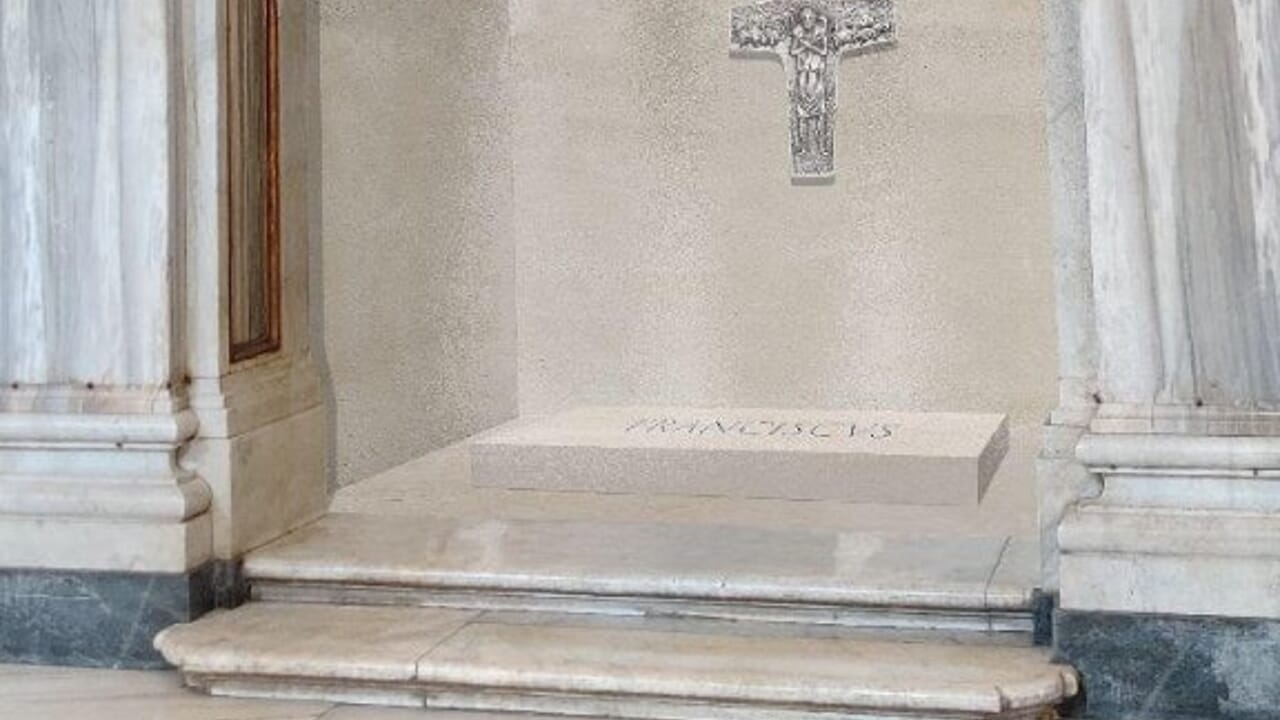
Pope Francis, who died on April 21 at 88, expressed his wish to be buried in the Basilica of Santa Maria Maggiore in Rome. “I ask that my mortal remains rest awaiting the day of resurrection in the Papal Basilica of Santa Maria Maggiore,” Bergoglio said in his will, released by the Vatican and written on June 29, 2022, almost three years ago. The Pontiff’s choice regarding his burial was, therefore, already known. Pope Francis’ funeral, a significant event in the Catholic world, took place on Saturday, April 26, the first day of the Novendiali, on the steps of St. Peter’s Basilica. The audience, filled with respect, paid their final respects to the beloved Pontiff.
Share: