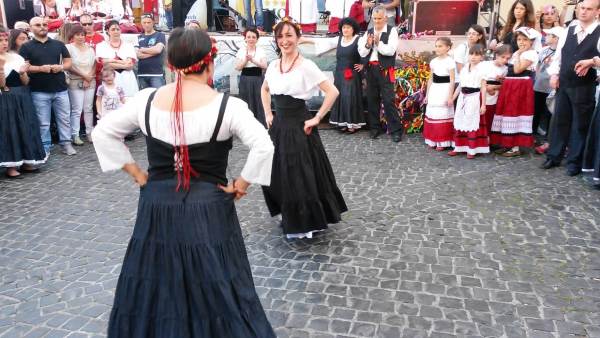
Strawberry Festival and Flower Show in Nemi: starting June 6, the village dresses up for the holidays. The Nemi Strawberry Festival is one of the most anticipated events in the Castelli Romani, where Nemi strawberries are famous throughout Italy for their bright colour and intense flavour.
The history of the Strawberry Festival of Nemi
According to local legend, the wild strawberries that are the festival’s heart were born from Venus’s tears for Adonis’s death, transforming into red hearts. Strawberries are also said to repel all pests, including snakes. Every year, as if reminding these legends, Nemi sends messages of love, unity, and power to the world.
The event has been repeated every first Sunday in June since 1922; the protagonists are Nemi’s strawberries and wild strawberries, small red fruits that are a source of pride for Castelli Romani. Nemi is filled with flowers and strawberries on Sunday and is full of historical re-enactments, folk dances, and tastes.
Strawberries and wild strawberries from Nemi have been known since ancient Rome, when they were eaten on the Ides of June during celebrations honouring Adonis. The pagan tradition continued into the Christian era, and for this reason, celebrations such as the “Triumph of Strawberries” were very popular in Rome. In fact, they were traditionally held on June 13 in Campo de’ Fiori, also celebrating the Catholic feast of Saint Anthony. The best strawberries in the Roman area were undoubtedly those from Nemi, as evidenced by several centuries of experience. They were considered a typical national product as early as a list drawn up in 1877. The community of Castelli therefore decided to celebrate its typical product with a festival that has been held since 1922. The symbol of this festival is the figure of the “fragolare”, or women who offered strawberries to passers-by on baskets and hampers.
The village is filled with flowers, and tourists can sample free fruit grown along the shores of Lake Nemi, amid historical reenactments and folk dances. The heart of the event: the parade of the “Fragolare,” the village girls, who for the occasion wear their ancient traditional costume (red skirt, black bodice, white blouse, and lace mandrucella on their heads). Nemi is one of those villages worth a visit even outside of the festival, because its panoramic setting and location on the lake’s volcanic crater create a truly evocative view. The village overlooks Lake Nemi, a small lake in the Castelli Romani area, also known for its historical connection to the sanctuary of Diana and Caligula’s ships, now exhibited in the Museum of Roman Ships. Strolling through the streets of the centre means alternating views of the lake, shops, cafes, and panoramic terraces. Among the most interesting spots to include on a short visit are the panoramic viewpoint and the Lovers’ Terrace, often considered among the village’s most beautiful views. If you have more time, it’s worth walking down to the lake or taking one of the trails connecting the lake to the town to appreciate better the connection between the village and the surrounding volcanic landscape. In practice, the festival can become the ideal excuse for a leisurely day of walking, photography, and food stops.
Reaching Nemi by car from Rome is easier: exit the Raccordo Anulare (ring road) on Via Appia, passing through Ciampino and continuing on Via dei Laghi, or via Genzano di Roma and Via Nemorense.
Public transport connections are also available. A train and bus option is available via San Gennaro, while other local signs confirm access from Genzano and stations in the Castelli Romani area.