
Pope Leo XIV’s Visit to Nicaea: Where Bridges Meet
Pope Leo XIV’s Visit to Nicaea: Where Bridges Meet The year 2025 marks an extraordinary moment for the Christian world. The Jubilee Year, declared sacred by the Catholic Church,…

Pope Leo XIV’s Visit to Nicaea: Where Bridges Meet The year 2025 marks an extraordinary moment for the Christian world. The Jubilee Year, declared sacred by the Catholic Church,…

Traces of the Roman Empire Iznik: The Silent Witness of Rome in Anatolia Nestled in the Marmara Region, the tranquil town of İznik—ancient Nicaea—stands as one of the Roman…

Philosopher Emperor Marcus Aurelius on Display in Ankara The International Archaeology Symposium, featuring the “Golden Age of Archaeology” exhibition featuring the statue of Marcus Aurelius, begins in Ankara on…

1,700-year-old tombs with links to a gladiator unearthed near Naples 1,700-year-old tombs with links to a gladiator unearthed near Naples A Roman necropolis has been discovered on the site…

The Traces of the Roman Empire:
Once upon a time, the ancient city of Aspendos had a good king. He loved his daughter, famous for her beauty, and his country “to the same extent”. One day, he had an idea for his two loves. He declared to his people that would marry his daughter to the person who rendered the most advantageous service to the city…

Ephesus was once the Asian capital of the Roman Empire: it was the jewel city of the time; as a cosmopolitan, cultural and commercial center, it was second only to Rome; The people called it the “second Rome.

Vincenzo Camuccini, The Death of Ceasar 15 March, in 44BC, Julius…

A statue of Hermes from the Roman Empire period has been found! A statue of Hermes from the Roman Empire period was discovered in the ancient city of Aspendos,…

The “Villa of the Mysteries” has been discovered in the ancient city of Pompeii A new Villa of the Mysteries has emerged from the excavations of Pompeii. A large…

Archaeologists found a Roman-era coffin covered in plaster A “high-ranking individual” covered in liquid chalk has been found buried in an ancient Roman-era cemetery discovered in England. Archaeologists have…

Pompeii: A large thermal complex has been discovered A sizeable thermal complex that remained for 2 thousand years under a layer of volcanic rock and ash inside a private…

The Baths of Caracalla returned to the water after 1500 years Like Caesar Augustus and Hadrian, Caracalla undertook a series of architectural projects to make himself famous, and this…

Who are those people in Pompeii? Touching figures frozen in time… A mother embracing her son, two sisters embracing each other… The secret of these moulds found in Pompeii…

The Appian Way is officially a UNESCO World Heritage Site The “Via Appia. Regina Viarum” is officially registered in the World Heritage List, thus becoming the 60th Italian site…
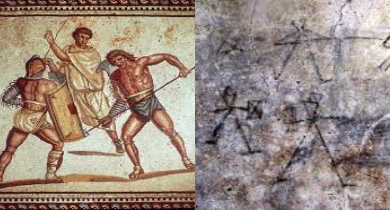
Among the latest discoveries made in the ruins of the ancient Roman city, gladiator drawings thought to have been inspired by children watching the battles in the amphitheatre were discovered.

In a remarkable archaeological find, the missing head of a statue of Hygieia, the goddess of health, has been unearthed in the ancient city of Laodicea. This head, a testament to ancient craftsmanship, is estimated to be approximately 2,100 years old, a rare and invaluable discovery.

A team of archaeologists from the University of Tokyo has discovered the lost house of the founder of the Roman Empire, waiting to be unearthed under a blanket of Vesuvius ashes.

Egnatia Road, is one of the most important roads connecting the two important capitals of the period, Rome and Istanbul, shining like a culture star from past to present.

Pompeii, a hall decorated with subjects inspired by the Trojan War emerges from the new excavations. Among the characters depicted are Helen and Paris, the Trojan prince who kidnapped Helen, wife of the Spartan king Menelaus, starting the Trojan War. The frescoes also depict the god Apollo and Paris’ sister, Cassandra, from whom he received the ability to predict the future, although his prophecies would never have been believed, not even by his own family.

An analysis of classical Greek and Roman medical texts has unveiled a startling revelation: severe memory loss was virtually non-existent 2,000 to 2,500 years ago, during the era of Aristotle, Galen and Pliny the Elder.

An approximately 1,800-year-old Roman statue was found in a parking in the United Kingdom.

A fresco depicting the mythological sisters Phrixus and Helle was found in the ancient Roman city of Pompeii. The scene depicts Phrixus escaping on the ram of the Golden Fleece with his twin Helle, whom he tries in vain to save after falling into the waves.
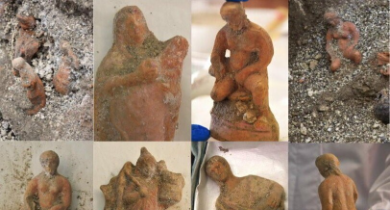
Thirteen terracotta figurines have emerged in Pompeii, traces of an ancient rite. The small sculptures, approximately 15 cm high, were upright on a horizontal plane inside a room.